Are we using the batteries we already have?
Fiona rang on Wednesday, the day after the Berkswell announcement.
"Two hundred megawatts, 857 MWh, a ten-year revenue floor agreed with a trading house, and construction already under way. Four-hour batteries are finally being built. Happy now?"
Happier. It's precisely what the system needs. The snag is that it won't be operational until late 2027.
"That's quick for infrastructure."
It is. But this summer's problems aren't waiting. Gas prices reached their highest level since early 2023. The average daily peak electricity price climbed to £158/MWh, against £105 last summer. Meanwhile, the grid connection offers promised for September have slipped to the end of October. That's the second delay.
"So we need more batteries, sooner. Nobody's arguing."
Quite. But there's another question worth asking. Are we making proper use of the batteries we've already got?
This summer, batteries offered the system operator more than twice as much energy as they did last year. The operator took almost exactly the same amount. Less than 6% of what was offered was actually dispatched.
"That's a control-room problem."
In part. But it also exposes a weakness in how we think about storage. If a battery's only purpose is to respond when somebody elsewhere gives the instruction, it can spend an awful lot of time doing nothing.
"What's the alternative?"
Give it a job of its own.
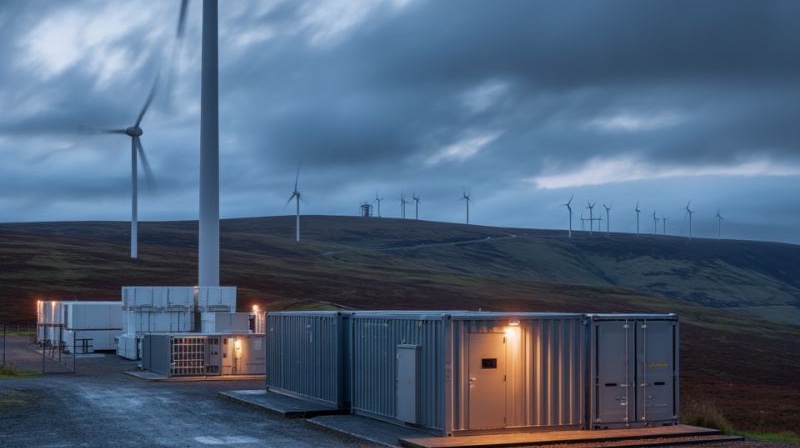
Take the wind-rich areas of northern Britain, where turbines are regularly switched off because the transmission lines heading south are already full.
Put three to ten megawatts of containerised computing capacity at those locations, with six to eight hours of battery storage alongside. The battery takes electricity that would otherwise be curtailed and keeps the computers running when the wind drops. A control system forecasts wind output, manages the battery and adjusts the computing load accordingly.
"And what does the grid get out of it?"
Something rather useful. A customer that consumes more when the network is congested and less when capacity is scarce. Each site is relatively small, built from standard containers, and can be replicated wherever the same constraints arise.
"So build both."
Exactly. Keep building the large grid-scale batteries. But build these smaller, locally useful systems as well, and don't wait.
As more wind and solar generation connects, the pressure on the system will only grow. A battery scheduled for 2027 cannot help with a constraint that's costing money today.
The question isn't simply how much storage we can build.
It's how much of the storage we've already paid for spends its day waiting for permission to be useful.