Stop waiting for a socket
James rang on Thursday with the Ofgem consultation open on his screen. “Ninety gigawatts of batteries built or in the queue. Twenty-nine needed by 2035. And now a fee just to stay in line. Isn’t that the market telling us we’ve got too many?”
Too many on paper. Nowhere near enough on the system.
Look at the same week. The Lords opened an inquiry into Dunkelflaute - those still, dark spells that arrive two to ten times a year and can last for a week. One house is worrying about too little power, the regulator about too much capacity waiting to connect. Both can be right. The swings are getting wider.
On 25 March, wind hit a record 23.9 GW and gas fell to just over 2% of the mix. Four weeks later, solar set its own record while wind dropped to about 2 GW. By half past eight, demand had risen by nearly 13 GW and gas had climbed from 1.6 GW to 8.7 GW.
Then, in June, power prices stayed below zero for nine hours.
Another 7.4 GW of wind and solar is due to come on this year. Negative-price hours are expected to more than double.
“So, batteries. Everyone agrees. Hence the queue.” Quite. But the queue fee is not expected to bite before next summer, and the big grid reinforcements will not arrive before the end of the decade.
The money is already there. In the US, $1.4 billion was raised this year for 1.5 GW of battery projects. In Britain, a solar-and-storage platform secured debt for an August merger.
Capital is not the scarce commodity. A place to plug in is. “Then what?” Stop waiting for a socket.
The power that most needs storing is already sitting at the far end of the wire — in the Highlands and the Moray Firth — where generators are being paid to switch off.
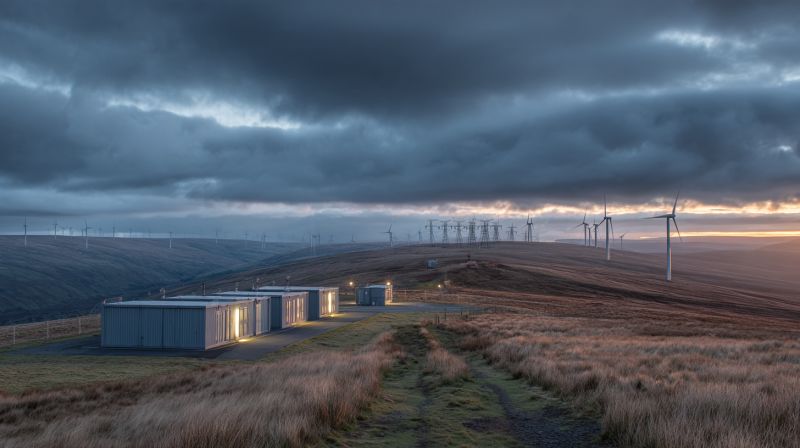
Put a battery behind a wind farm’s existing connection and it joins no queue. Add a few megawatts of interruptible compute beside it, sized to absorb a curtailment window, and the site can use power when the system is awash with it, then stand down when supply tightens.
Two forms of flexibility on the same pad.
“Small, though.” Small, yes. But buildable this year.
A gigawatt that connects in 2030 is no help in the winter of 2026.
Every year we wait, the swings grow larger and the queue grows longer.
Once the queue starts charging rent, the more useful question is where the money goes instead.